
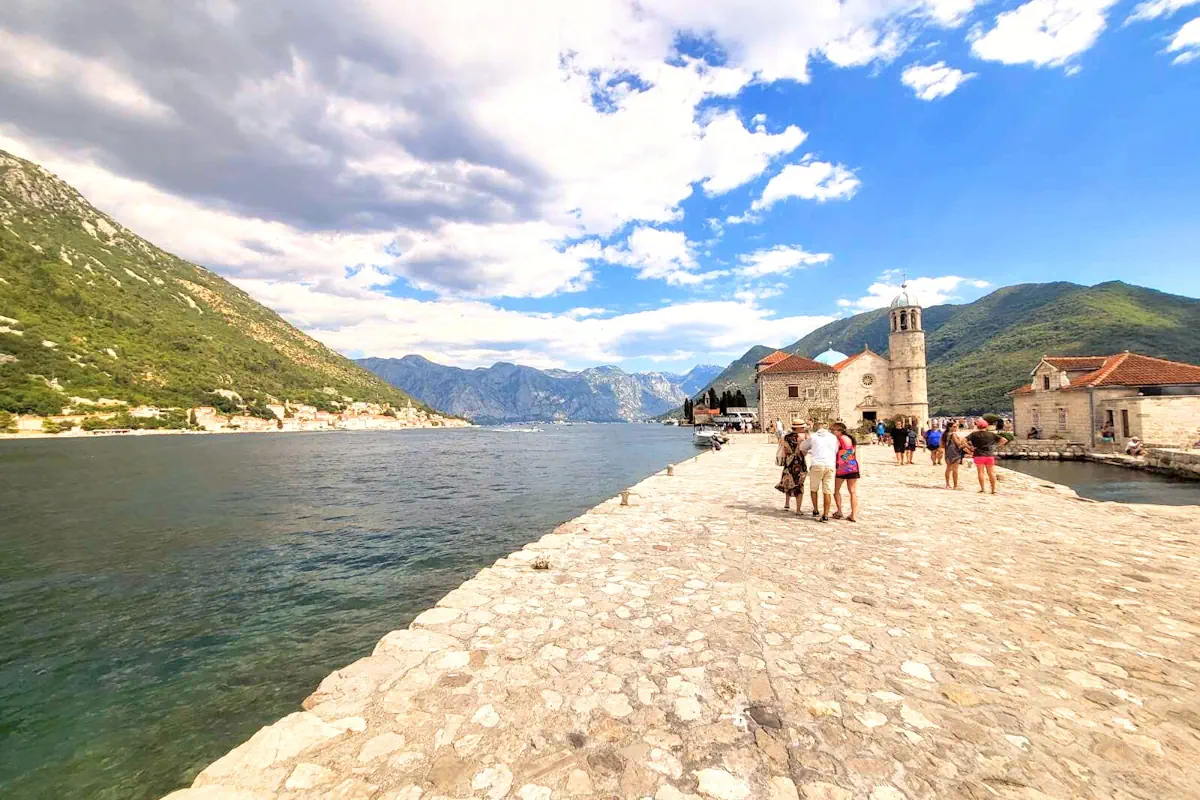
Our Lady of the Rocks (Gospa od Škrpjela) is a world-famous artificial island and 15th-century Roman Catholic church located 500 meters off the coast of Perast. It is the most iconic landmark in the Bay of Kotor, known for its sky-blue dome, stunning Baroque art, and the 500-year-old legend of its creation.
Just a short boat ride from Perast’s waterfront stands one of the most emblematic edifices along Montenegro’s coast. Perched above a small man-made island, the Church of Our Lady of the Rocks is impossible to miss with its distinctive sky-blue cupola and belfry.
As one of Europe’s most picturesque Byzantine-style structures, the island is a magnificent sight to behold against the backdrop of the surrounding limestone peaks. For centuries, the navigation light by the bell tower has served as a silent sentinel. Even today, mariners departing on long ocean voyages salute the church with their horns, a living tradition of gratitude upon entering or leaving the narrow Verige Strait.
Visitor Essentials
Location
Perast (Offshore Island)
Boat Taxi
5€ Return (from Perast Marina)
Entrance
Church: Free | Museum: 2€
Dress Code
Shoulders & Knees Covered
Book a Boat Tour from Kotor
The man-made island is the only one of its kind in the Adriatic Sea.
The Legend of Gospa od Škrpjela
A miracle found on a jagged ridge in the sea.
The story of Our Lady of the Rocks began on July 22nd, 1452. According to local lore, two brothers from the Mortešić family were returning from a difficult fishing trip when they spotted a strange light on a small rocky outcrop (a škrpjel) jutting out of the water.
Upon closer inspection, they found an icon of the Virgin Mary and Child. They carried the icon back to St. Nicholas’ Church in Perast, but by the following morning, the painting had mysteriously vanished. It was found again on the exact same rock in the middle of the bay. The townspeople took this as a divine command: the Virgin Mary wanted a home on that very spot.
However, there was one major problem: there was no land to build on. Undeterred, the people of Perast swore an oath to build an artificial island, a task that would eventually take nearly 200 years to complete.
Island and Church Construction
- Scuttled Ships: Over 100 old sailing vessels and seized Ottoman battleships were filled with rocks and sunk around the reef.
- The Seaman’s Oath: Every sailor returning from a successful voyage was required to drop a rock at the site.
- Quarry Stones: Massive amounts of stone were ferried from the mainland to fill the gaps between the ship hulls.
When a larger church was built in 1630, the old chapel was integrated into the structure. The iconic blue cupola and octagonal chapel were added between 1720 and 1725.
The Baroque Masterpiece
Inside the Sanctuary of the Bay
Step inside and you will understand why many call this the most beautiful sacred site in Montenegro, a gallery of faith suspended over the Adriatic.
68 Canvases by Tripo Kokolja
The walls and ceiling are adorned with a massive cycle of 68 paintings by the 17th-century Baroque master Tripo Kokolja. The crown jewel is the 10-meter-long Death of the Virgin, a dramatic masterpiece likely inspired by the light and shadow of Caravaggio.
2,500 Silver Votive Plates
Between the lower and upper walls runs a shimmering belt of silver. These plates were donated by local seafarers in gratitude for surviving pirates, storms, and illness. Look closely, and you’ll see nautical scenes and even “body parts” representing healed limbs.
The 1654 Battle of Perast
One silver votive tablet stands out from the rest. This special plaque was gifted to the church by townspeople after they defended Perast against outnumbering Ottoman forces in 1654. The victory is still celebrated every May 15th during the “Shooting the Rooster” event, when the icon and this specific plaque are brought to the mainland for public veneration.
The Carrara Marble Altar
Sculpted by the Genoese artist Antonio Capellano in 1796, the main altar is a triumph of white marble. It houses the original 15th-century icon found by the fishermen. Pro-tip: Walk behind the altar. There is a small opening where you can reach in and touch the original jagged rock upon which the icon was first discovered, a tradition said to grant a traveler’s wish.
The Maritime Museum: 2,000 Years of History
Adjacent to the church is the museum (admission: €2), housed in the former priest’s quarters. While small, it is an eclectic treasure trove that spans from the Bronze Age to the height of Perast’s naval power.
The collection bears witness to the region’s long and fascinating maritime history. You’ll find Greek-Illyrian ceramics, Roman amphorae used for transporting wine and oil, and hundreds of the silver votive plates that didn’t fit on the church walls.
Notable Exhibits
- Bronze Age Stone Tools Prehistoric
- Illyrian & Roman Artifacts Ancient
- Ottoman Weapons & Shields 17th Century
- Naval Navigation Tools Baroque
The museum houses centuries of maritime devotion and local craftsmanship.
The Tapestry of Jacinta Kunić
On the second floor sits the museum’s most enthralling – and tragic – piece: an embroidered picture of Mary Magdalene by Jacinta Kunić. It is a work of exceptional skill, using the complex punto pitura technique with 650 stitches per square centimeter.
The story behind it is painfully sad. Jacinta’s husband, a sea captain, departed for a voyage and never returned. For 25 years, she waited, channelling her hope and grief into this tapestry. She used silk, gold, and silver threads, but as she ran out of materials, she began to use strands of her own hair.
Look closely at the hair of the angels and the Virgin Mary. At the top, the hair is dark, the color of Jacinta’s youth. Toward the bottom, the hair turns grey and white, marking the decades she spent waiting for a ship that never came home.
Annual Event
July 22nd
July 22nd
The Fašinada Tradition
Every July 22nd at sunset, the local Fašinada takes place. This 500-year-old regatta involves residents tying their wooden boats together and rowing out to the island to drop stones into the sea. This UNESCO-listed tradition is a functional necessity designed to prevent the Adriatic from eroding the artificial island’s foundation.
Plan Your Visit
Reaching Our Lady of the Rocks
From Perast Marina
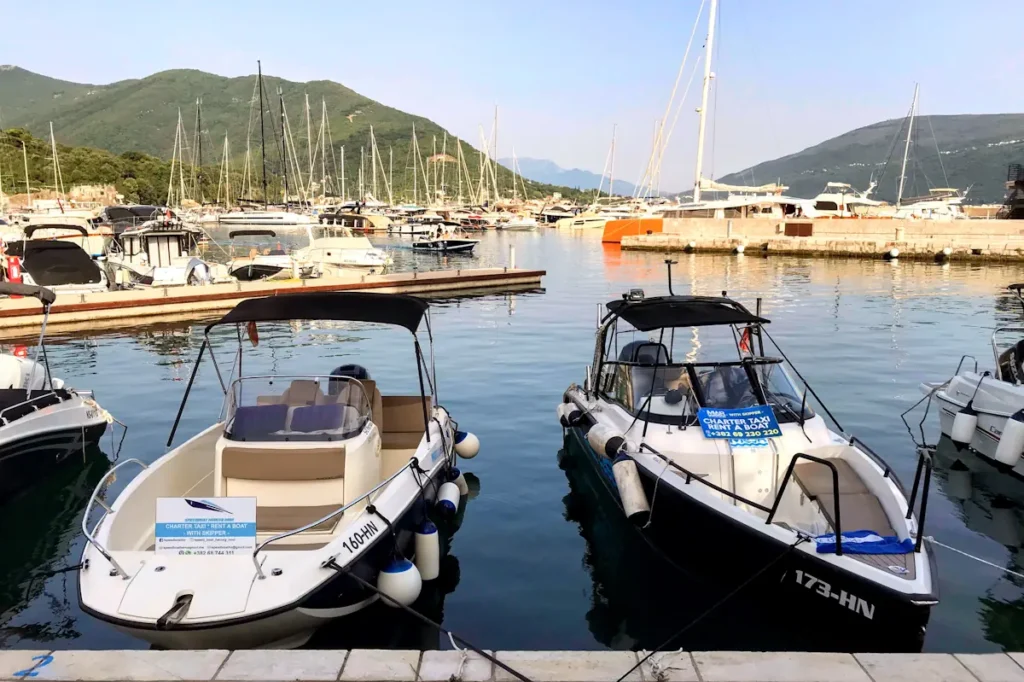
Water taxis depart every 15 minutes from the waterfront. Simply head to the docks; no advance booking is required.
5€ Return TripFrom Kotor Old Town
Speedboat tours from Kotor include the island as a scheduled stop. This is the most efficient way to combine the island with the Blue Cave.
Book Boat Tour 2 to 3 Hour ToursPrivate Bay Charter
Book a private skipper for a custom route including the island, the Blue Cave, and Mamula. Perfect for groups and golden hour photography.
Reserve Private Boat Full Day & Half Day
Visitor Note: The island and church are not wheelchair accessible due to the uneven stone foundation and the narrow stairs within the museum. To avoid the peak crowds from cruise ship excursions, we recommend visiting before 10:00 AM or after 5:00 PM.
Expand Your Horizon
Beyond the Artificial Island
Continue your journey through the hidden corners of Boka Bay.
Kotor Old Town
The beating heart of the bay. Navigate a labyrinth of Venetian streets and climb the ancient fortress walls.
Explore Kotor →Herceg Novi
Known as the city of sun and stairs, this coastal gem marks the entrance to the bay with fortresses and botanical gardens.
Visit the City of Sun →Ancient Risan
Just minutes from Perast, Risan is the oldest settlement in the bay, famous for its remarkably preserved 2nd-century Roman mosaics.
Discover Ancient History →