

The Twin Towers of St. Tryphon Cathedral Kotor

Inside St. Tryphon Cathedral: Kotor’s Asymmetrical Masterpiece (2026)

St. Tryphon Cathedral: The Asymmetrical Soul of Kotor

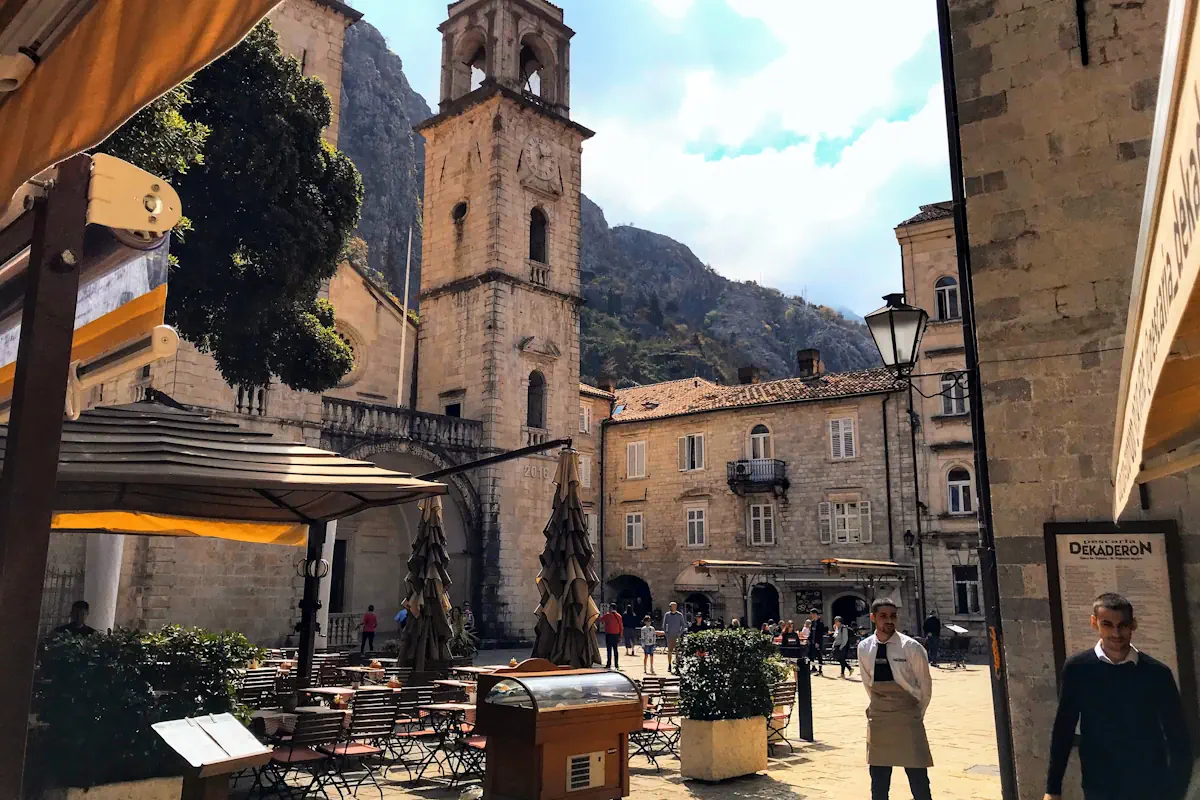
The St. Tryphon Cathedral (Kotor Cathedral) is a 12th-century Romanesque masterpiece and the most iconic landmark in Kotor’s Old Town. Originally consecrated in 1166, this Catholic cathedral is famous for its asymmetrical bell towers and for housing the silver-encased relics of Saint Tryphon, the patron saint of Kotor. As one of the oldest and tallest churches in Southeastern Europe, it remains the spiritual heart of the Boka Bay.

Standing tall in the heart of the UNESCO-protected center, this imposing white edifice is a magnificent sight for those arriving by sea. Its most intriguing feature is the pair of Baroque bell towers which rise to 35 meters. If you look closely, you will notice the northern tower is two meters shorter than its southern neighbor; the upper portion was never completed, presumably due to a lack of funds during the reconstruction following the devastating earthquake of 1667.

Over the centuries, the cathedral has evolved into a living timeline of Mediterranean architecture. While the core remains Romanesque, the façade and interior are a complex tapestry of Gothic, Renaissance, and Baroque details, each layer telling a story of the various empires and artists who sought to leave their mark on Kotor’s most sacred ground.

Visitor Essentials

Location St. Tryphon Square (Pjaca Svetog Tripuna)
Entrance Fee 4€ (Includes Relic Chapel & Museum)
Opening Hours 9 am to 6 pm (Seasonal variations)
Main Highlight The Silver Altarpiece & Relic Chapel

Dress code: Shoulders and knees must be covered to enter the cathedral and the upper museum galleries.

Close up of the Romanesque and Baroque architectural details of St. Tryphon Cathedral, Kotor

Andreaccio’s Mission: A 9th-Century Legacy

The story of the cathedral began in 809 AD, back when Kotor was a frontier of the Byzantine Empire. A prominent local named Andreaccio Saracenis traveled to Constantinople (modern-day Istanbul) on a high-stakes mission: to acquire the sacred relics of Saint Tryphon. He was successful, returning to Kotor with the saint’s remains and building a modest chapel to house them.

By 1166, Kotor’s prestige had grown so much that the small chapel was replaced by the massive Romanesque cathedral we see today. It was designed to be a “fortress of faith,” a safe sanctuary for the saint’s remnants, which were conserved in a handcrafted silver reliquary casket where they remain to this day.

Over the centuries, nature forced the cathedral to evolve. Following the catastrophic earthquake of 1667, the building was heavily restored, leading to the unique mix of Romanesque, Gothic, and Renaissance styles that define its current silhouette.

Masterpieces of the Main Nave

Step inside the cathedral, and you are immediately met by a series of brick and Corinthian pillars that divide the naves, set against a stunning floor of inlaid marble mosaic. While the walls were once covered in vibrant 14th-century frescoes, only a few precious fragments remain today.

The visual anchor of the interior is the Great Ciborium (stone canopy) from the late 14th century. Likely the work of a pupil of Vitus of Kotor, this masterpiece features pre-Romanesque interlace and was designed to complement an even older 9th-century ciborium. In earlier centuries, this structure included curtains that would be drawn closed during the most sacred liturgical services.

Behind the red-marbled ciborium sits the Silver Altarpiece, a collaborative triumph by artists from Kotor, Venice, and Switzerland. This piece depicts twenty biblical characters, including John the Baptist and the Apostles. Most notably, it features Saint Tryphon himself, holding a miniature model of Kotor – complete with its city walls and fortress – symbolizing his eternal protection over the town.

Key Artistic Details

  • The Silver Altarpiece: Look for the central figure of St. Tryphon (1378) holding a palm frond and a tiny model of the city.
  • John of Basel (1440): Forged the striking silver figures of Saint Peter and Christ.
  • Venturin (17th Century): The Venetian goldsmith who added the reliefs of Saint Jerome and St. Francis.
  • Venetian Marble Altars: Four 18th-century altars representing the height of Montenegrin Baroque art.
  • The Ciborium Architrave: Intricate carvings depicting scenes from the life of the saint.

The Relic Chapel: Two Masterpieces of Sacred Silver

Upstairs, behind a large red wrought-iron gate adorned with a 17th-century silver antependium, lies the Relic Chapel. This striking circular red room, designed by Francesco Penso Cabianca, features a star-studded ceiling and houses two primary treasures: the Reliquary of the Glorious Head (13th–17th cent) and the Great Silver Casket.

The Great Silver Casket is a mid-16th-century chest that conserves several bones of the patron saint. It is famous for its graphic relief plates depicting the martyrdom of Saint Tryphon. One relief shows how he is violently quartered by horses, while another portrays him being whipped. A third relief paints a vivid picture of the saint being tortured by fire and stoned to death.

Historical Context

The assembly of this silver casket coincides with the Ottoman advances into the Bay of Kotor (1539). Interestingly, the figures shown decapitating the saint and presenting his head to Aquilinius are depicted as bearded and turbaned warriors in Turkish military dress.

Sacred Artifacts Guide
  • 1. The Glorious Head: A specialized reliquary for the skull of St. Tryphon.
  • 2. The Great Silver Casket: The bone-conserving chest featuring the martyrdom reliefs.
  • The Sarcophagus: The original 9th-century marble box used for the initial transport from Constantinople.
  • Minor Reliquaries: Collections of limb-shaped containers and fragments of the True Cross.
  • Stones of the Passion: Artifacts said to be the stones thrown at Jesus during his trial.

Visitor Note: There is a small entrance charge to access the Relic Chapel and the upper-floor museum.

Living Traditions: The Boka Navy

The cathedral is not merely a museum of the past; it is the stage for the St. Tryphon’s festivities, a two-week celebration in January and February. These traditions are inseparable from the Boka Navy, a maritime organization dating back to the 9th century. On January 27th, navy members in traditional uniforms perform the UNESCO-listed Kolo circle dance right here on the cathedral square.

The climax occurs on February 3rd, when the skull and bones of the patron saint are carried in a solemn procession through the cobblestone streets. Thousands of locals and visitors jam the narrow corridors to witness the “Glorious Head” being returned to its sanctuary, a ritual that has defined Kotor’s identity for over a millennium.

UNESCO Intangible Heritage

The Boka Navy’s traditions and the Kolo dance are officially protected by UNESCO, representing the deep maritime soul of the Bay of Kotor.
The silver altarpiece nave and Corinthian pillars inside St. Tryphon Cathedral, Kotor
Andreas
Andreas

I am a resident (and citizen) of the Montenegrin coast, dedicated to uncovering the authentic side of the Adriatic beyond the typical tourist brochures. Whether I’m exploring the Grbalj hinterlands for the best local produce or navigating the ancient alleys of Kotor’s Old Town, my guides are built on first-hand experience and a love for Montenegro’s complex history.

Articles: 179
NOTES FROM THE FIELD

The Adriatic, Un-googleable.

A monthly dispatch for those who prefer the quiet path. Join us for hidden secrets and veiled narratives from the coast.