

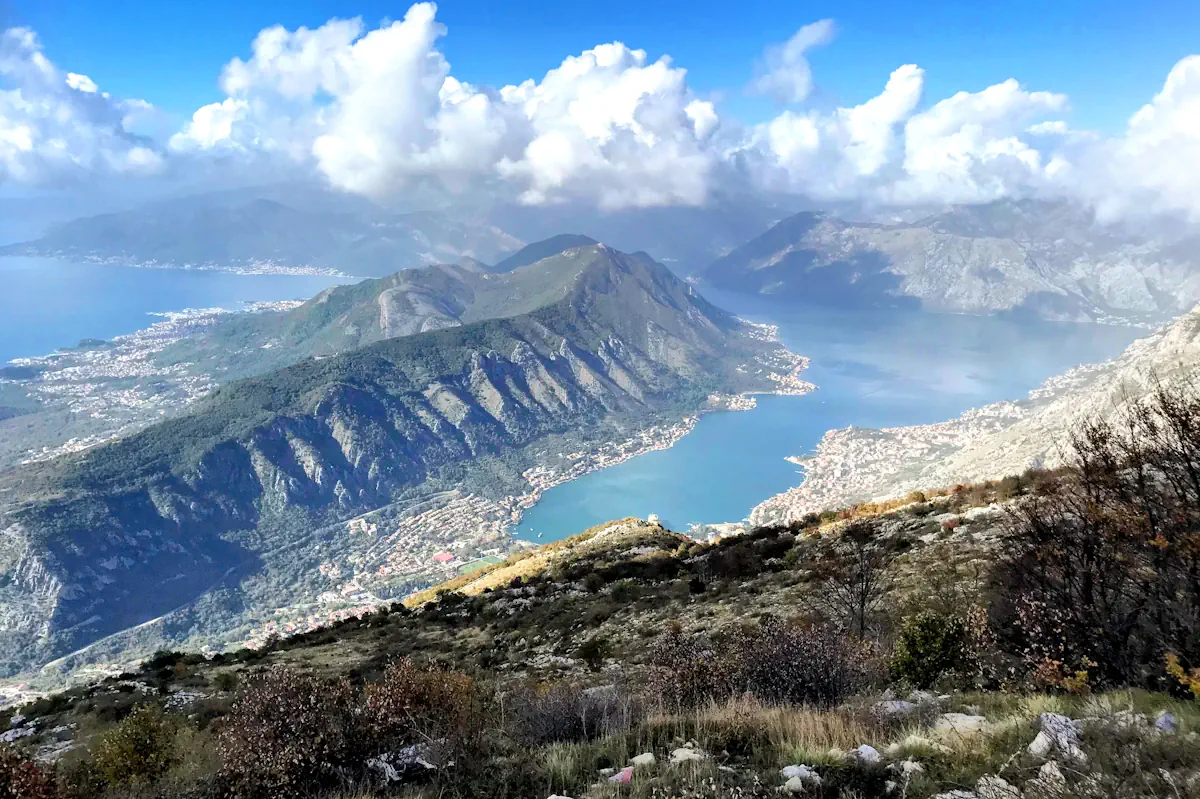

Many believe that the best way to see the mesmerizing Bay of Kotor is by taking a cruise, but this assertion is probably wrong. Hiking up the Ladder of Kotor, or the ‘Old Montenegrin Road’ as it is locally known, and seeing the fjord-like inlet from above will surely be an unforgettable experience.
The Ladder of Kotor is part of a centuries-old trade route, linking Kotor with the former Royal Capital of Cetinje. Between the 14th and 18th centuries, it served as a steep and narrow window into the world. Back in the day, manufactured goods, vegetable oils, and salt went up the Ladder to be exchanged for meat, dairy, and livestock. Presumably, even the prince’s snooker table, exhibited today in the Biljarda in Cetinje, was dragged along this path.
Stage 1: The Trailhead & Initial Ascent
The Ladder of Kotor hike starts from the trailhead next to the old hydroelectric power plant. It is easily accessible from Kotor’s Old Town via the Northern Gate, simply by crossing the Scurda River. From there, you can already see the first in a series of 70 or so switchbacks up the Krstac Pass. The path starts as a rocky and quite steep mountain trail but delivers fantastic views of the Bay of Kotor and unique angles of Kotor’s City Walls in return – just a couple of minutes into the hike.
Stage 2: The Hamlet & The Mountain Cafe
After roughly 45 minutes of climbing and 260 meters of elevation gain, the rugged trail gives way to a tiny, secluded hamlet, home to just five permanent residents. Here, you will find an authentic family-run tavern that serves as a vital pitstop for hikers. This is not your typical tourist cafe; it is a rustic hillside eatery that delivers some of the most profound views of the Boka Bay from its lofty outdoor terrace.
A Traditional Balkan Fuel-Up
Treat yourself to loaves of delicious homemade bread and farm-fresh goat cheese. Drinking rakija (typically homemade grappa or plum brandy) is what the locals prefer in Montenegro. Don’t be surprised to see the husband-and-wife team offering you a glass as early as 9 am; it’s a permanent fixture of the traditional Balkan morning routine, right alongside a cup of freshly-brewed Turkish coffee.
With the bay shimmering below and the rugged peaks of the Lovćen massif towering above, this stop is as much about the hospitality as it is about the scenery. Once you’ve boosted your energy levels with local produce, you’ll be ready to tackle the next milestone of the ascent toward the Praćište Ridge.
Stage 3: The Secret Pass & The Hidden Wall
From the cafe, a trail breaks off to the right, taking you to the abandoned Church of Saint Juraj (which has some nice and vibrant frescoes) and further to Kotor Fortress, which may or may not be accessible via a hidden wall passage.
Note: This “window” in the fortress wall is a legendary shortcut for hikers who want to transition from the free Ladder trail into the upper levels of the San Giovanni fortifications.
The Praćište Ridge sits at about 600 meters above sea level. The views are breathtaking from here and well worth the effort – even if you choose not to push for the summit. If your primary goal is photography and vistas, the visual reward remains largely the same throughout the final third of the trail.
Stage 4: The Forest Ascent & The Summit Reward
For everyone else, the remaining 1 – 1.5 hours are characterized by a long and steady ascent through dense forests (no sea views) with an elevation gain of more than 300 meters. The entire Ladder of Kotor trail (uphill) will take the average fit hiker three hours to complete. The trail ends at the Nevjesta Jadrana Restaurant, which serves traditional Montenegrin cuisine – the perfect fuel after the strenuous ascent.
Hiking Downhill: The Easier Option
There is a reason that you hardly sweat hiking downhill – it is much easier and takes less time. For the average hiker, it takes between 2 and 2.5 hours to complete the 6.5-km-long trail downhill. The path starts at the Restaurant Nevjesta Jadrana, from where you need to traverse the hill downward through dense forest before reaching the Praćište Ridge one hour into the hike, and then further down along the zig-zag stone path. Remember, the path is in good shape but can be slippery, especially after heavy rain.
Before You Go: Essentials
- ✔️ Footwear: Hiking boots are a must; the trail is slippery when wet.
- ✔️ Water: Bring plenty; the only cafe is 45 minutes into the hike.
- ✔️ Timing: Start early. The fortress is in the shade in the afternoon, making for better photos.
- ✔️ Navigation: Use a charged phone to capture the 72 switchbacks.
Beyond the Ladder: Lovćen & Njeguši
The Krstac Pass acts as the dramatic dividing line between coastal and continental Montenegro, sitting at the foot of Lovćen National Park. For the truly ambitious, the trail doesn’t end here. Many experienced hikers continue toward Jezerski Vrh (1,657 meters), the rugged peak that houses the famous Njegoš Mausoleum.
The Summit of Lovćen
Once you reach the base of the peak, you can choose to take the 461 stone steps leading up to the mausoleum or follow the narrow mountain pathway. This is the resting place of Petar II Petrović-Njegoš, a 19th-century ruler and poet who wished to be buried amidst these “grey peaks.”
From the observation deck, you are rewarded with 360-degree views that stretch across nearly all of Montenegro. By the time you reach this point, you will have covered a staggering 14.5 kilometers from the trailhead in Kotor.
If you prefer a different kind of adrenaline, there is a zip line located just 500 meters north of the Nevjesta Jadrana Restaurant, offering a flight over the rugged terrain of Boka Bay.
Finally, no visit to this region is complete without stopping in Njeguši. This small hamlet is the birthplace of Njegoš and is legendary for its Njeguši Prosciutto and Cheese. You can even visit the ruler’s birth house, which has been preserved as a small ethnographic museum – the perfect cultural bookend to a day of physical exertion.
