
The official language of Montenegro is Montenegrin. While it is the nation’s primary tongue, it exists within a linguistic continuum; if you speak Serbian, Croatian, or Bosnian, you will be understood perfectly. In 2026, travelers will find that English is the unofficial second language of the coast, particularly in Kotor, Budva, and Tivat.
Interactive Phrasebook
The Twelve Essentials
Tap the play icons to hear the local pronunciation for these essential travel phrases.
GOOD DAYDobar dan
THANK YOUHvala
PLEASEMolim
EXCUSE MEIzvinite
YES / NODa / Ne
AGREED / OKMože
THE BILLRačun, molim
BON APPÉTITPrijatno
CHEERSŽivjeli
HERE YOU GOIzvolite
HOW MUCH?Koliko košta?
HI / BYEĆao
Will I Struggle With Only English?
For most travelers from the US, UK, and Canada, the fear of a language barrier is the #1 hurdle. In Montenegro’s main coastal hubs and tourist centers, the short answer is no.
Montenegro is a tourism-driven economy, and the younger generation (under 40) generally speaks excellent English. However, the level of proficiency shifts dramatically based on where you are in the country.
The Coastal Hubs
Kotor, Budva, Tivat, Herceg Novi
English is the lingua franca here. In hotels, high-end restaurants, and tour agencies, you will rarely encounter a gap. Most menus are printed in Montenegrin and English. You can comfortably navigate these cities with zero local language skills.
Administrative Capitals
English is widely spoken in professional settings, modern cafes, and malls. You might find a slight dip in smaller, family-run pekara (bakeries) or local markets, but a few of the “Twelve Essentials” above will get you exactly what you need.
The North & Rural Villages
Durmitor, Biogradska Gora, Prokletije
This is where your phrases become “social gold.” In mountain Katuns (shepherd huts) or rural guesthouses, English proficiency drops significantly. Older generations may speak some German or Russian instead.
The “Language Hierarchy” of Montenegro
If you speak other languages, they can be incredibly useful backups:
- • Russian: Historically common due to tourism and property investment.
- • German: Often spoken by older generations who worked in Western Europe.
- • Italian: Common on the coast (Bar/Kotor) due to historical maritime ties.
“Language in the Balkans is a mirror of identity. While linguists may see one language, the heart sees heritage.”
The Nuance of Identity
In Montenegro, the question “What language do you speak?” often receives a nuanced answer. While Montenegrin is the sole official language, the population remains linguistically diverse. According to the 2023 Census, roughly 43% of the population identifies their native tongue as Serbian, while 36% identifies as Montenegrin.
For the traveler, this distinction is largely invisible. Whether someone identifies their speech as Montenegrin, Serbian, or Bosnian, they are speaking the Shtokavian dialect. You will find the strongest identification with the Montenegrin language in the old royal capital of Cetinje and along parts of the coast, where the language is seen as a vital pillar of national independence.
A Unified Tongue
In 2017, prominent figures across the Balkans signed a declaration confirming that Montenegrin, Croatian, Serbian, and Bosnian are essentially the same language. For you, this means that the few phrases you learn here will grant you “linguistic keys” to almost the entire Western Balkan region.
Cracking the Code
Phonetics & Pronunciation
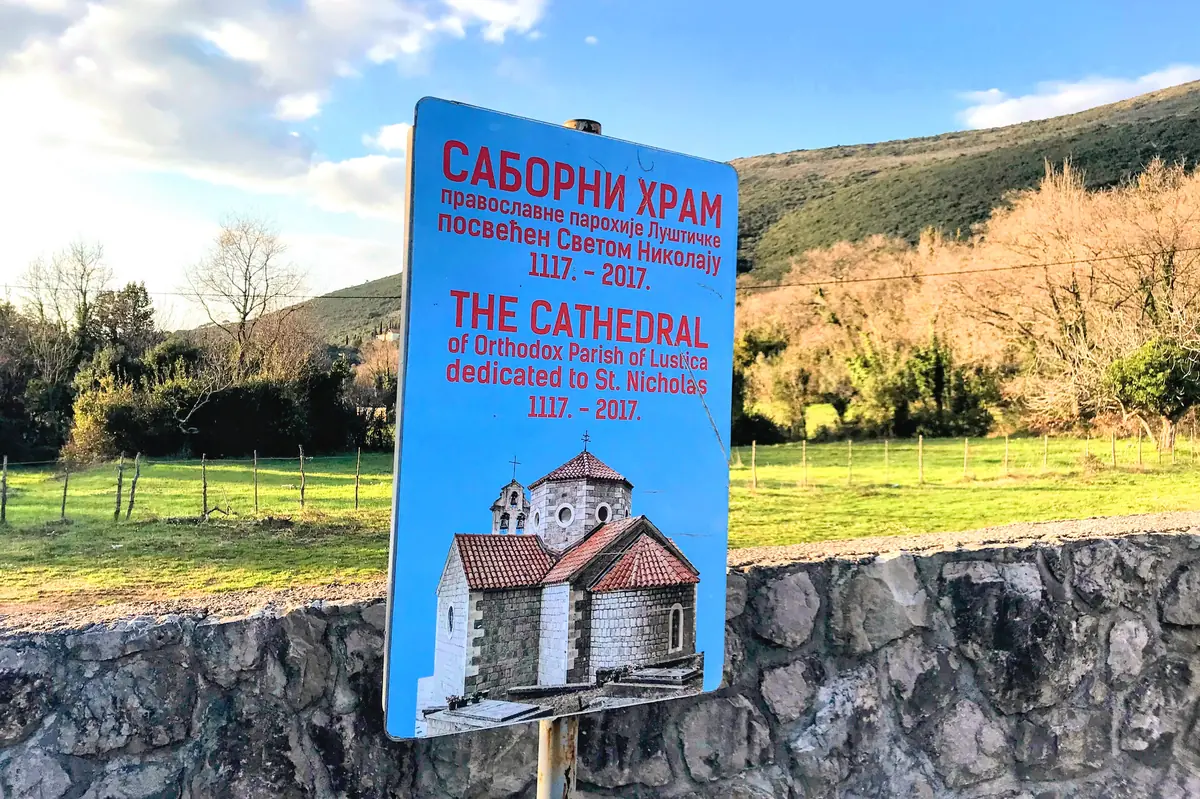
Montenegrin uses both Latin and Cyrillic alphabets, but you will mostly see the Latin version on the coast. It is a purely phonetic language; once you learn these 6 letters, you can read any sign in the country.
| LETTER | PRONUNCIATION | AS IN… |
|---|---|---|
| C | Sounds like TS | Ca-ts |
| Č / Ć | Sounds like CH | Ch-ips |
| Š | Sounds like SH | Sh-oe |
| Ž | Sounds like ZH | Plea-s-ure |
| J | Sounds like Y | Y-ellow |
| R | Always Rolled | Like in Spanish or Italian |
Why this matters: You’ll see the city Herceg Novi written everywhere. Using the table above, you now know it is pronounced “Her-tseg No-vee”, not “Her-keg”.
The Script
Montenegro’s Dual Alphabet
Montenegrin linguists have established a perfect one-to-one correspondence between the two scripts. For every Latin letter, there is exactly one Cyrillic counterpart.
Note: Ś and Ź (С́ and З́) are the two unique letters introduced to reflect specific Montenegrin pronunciation. In common practice and on older signs, you will still frequently see the standard Slavic S and Z used.
Deepen Your Connection
Going Beyond the Basics
If you want to move from “tourist” to “insider,” these are the two most effective tools for mastering the sounds of Montenegro.
italki: Private Tutors
Connect with 1-on-1 native speakers specifically from Montenegro. This is the only way to hear the local Kotor or Podgorica lilt before you land.
Find a Tutor → Pimsleur: Audio MasteryPerfect for the plane ride. Using their Croatian/Serbian course will train your ear to handle the specific sounds and grammar of the Balkans.
Start Audio Lessons →Disclosure: This post contains affiliate links. If you choose to purchase a course through these links, I may earn a small commission at no extra cost to you, which helps keep Adriatic Ways running. Hvala!
