
The Bulwark of the Scurda River
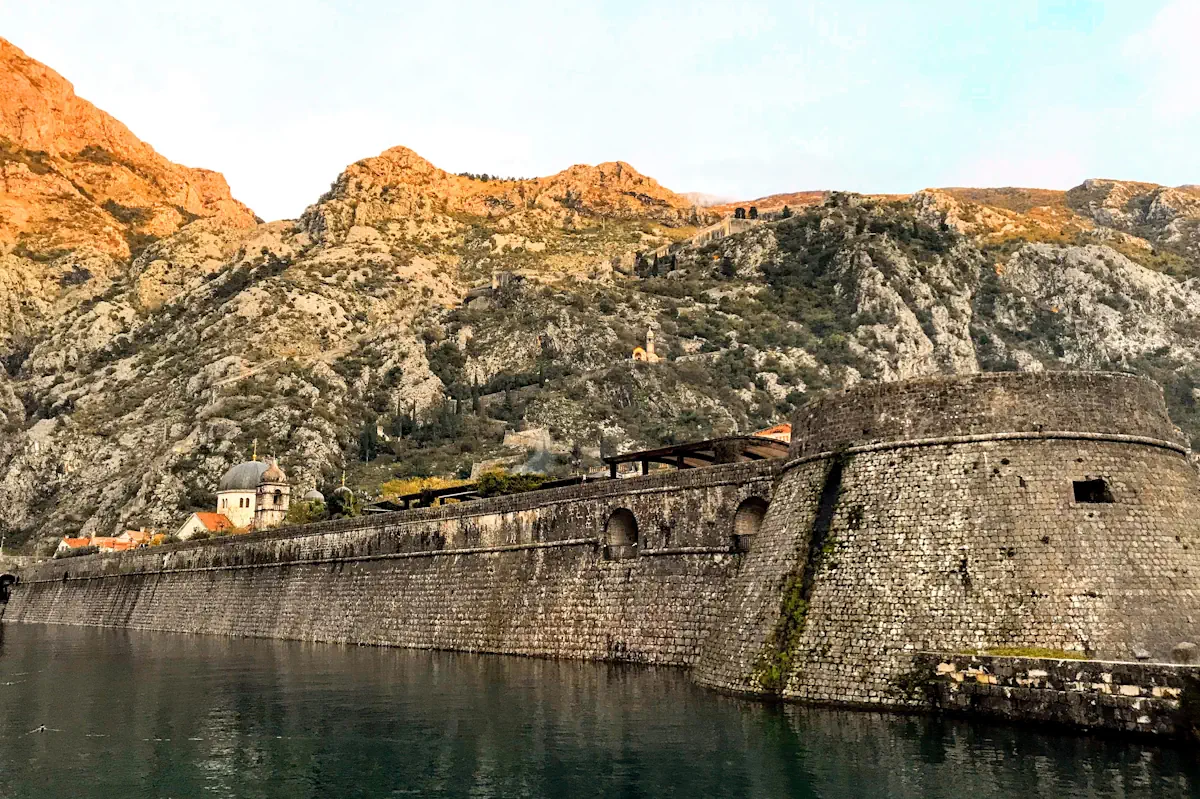
The Kampana Tower is the most recognizable element of Kotor’s 4.5 kilometer long defensive stone walls. Anchoring the river facing north wall to the western ramparts, this bell shaped bastion is often the first landmark visitors notice when arriving by sea or from the northern Benovo entrance.
First erected between the 13th and 14th centuries, the tower was completely rebuilt in the mid 1600s during the height of the Venetian Republic. Its massive, rounded silhouette was specifically engineered to deflect cannon balls, a design that proved vital as the Ottoman Empire began its westward expansion across the Adriatic.
Quick Reference
Deflection by Design
The strategic success of this bastion lies in the scarped base and sloped walls. While medieval towers relied on sheer height, the Kampana Tower utilizes a low center of gravity and a flared foundation. This prevents attackers from easily undermining the base and ensures the structure remains stable even under heavy bombardment.
The interior architecture features a robust stone staircase that allowed soldiers to move artillery and supplies quickly to the upper platform. From this vantage point, the defenders maintained a wide arc of fire across the harbor, making the northern entry to Kotor virtually impenetrable by sea during the height of the Venetian era.
Panoramic Observations
The upper ramparts provide one of the most comprehensive perspectives of the UNESCO site. From this elevation, you can observe the intersection of the city walls and the surrounding geography, including the turquoise flow of the Scurda River and the historic roofs of the Square of Arms.
Discover more UNESCO Sites in Montenegro →The Shield Against the Ottoman Empire
By the early 16th century, the expansion of the Ottoman Empire presented an immediate threat to the Venetian territories in the Adriatic. The pivotal moment for Kotor’s defense came in 1539 following the Siege of Castelnuovo in nearby Herceg Novi. The fall of that fortress to Hayreddin Barbarossa forced the Venetian Republic to drastically modernize the fortifications surrounding the Old Town.
While the Kampana Tower required only minor structural upgrades during this period, the urgency of the Ottoman threat led to the completion of the Bembo Bastion and the North Gate by 1540. These combined efforts ensured that Kotor remained one of the few strongholds in the region that was never conquered by the Ottoman forces.
Historical Significance
The Kampana Tower is a vital component of the Venetian Works of Defense. Since 2017, it has been protected as part of a serial UNESCO World Heritage site that spans the former maritime borders of the Venetian Republic across Italy, Croatia, and Montenegro.
Beyond the Old Town Walls
Kotor is the perfect base for exploring the rest of Boka Bay.
Perast & The Islands
A 15 minute drive to the most romantic village in the Adriatic and its floating church.
Explore Perast →The Serpentine Road
25 hair-pin turns leading to Mount Lovćen for the absolute best view of Montenegro.
Drive the Serpentine →Dobrota Promenade
Often called the local’s Kotor, this area is perfect for sunset walks and seaside dining.
Walk the Coast →