

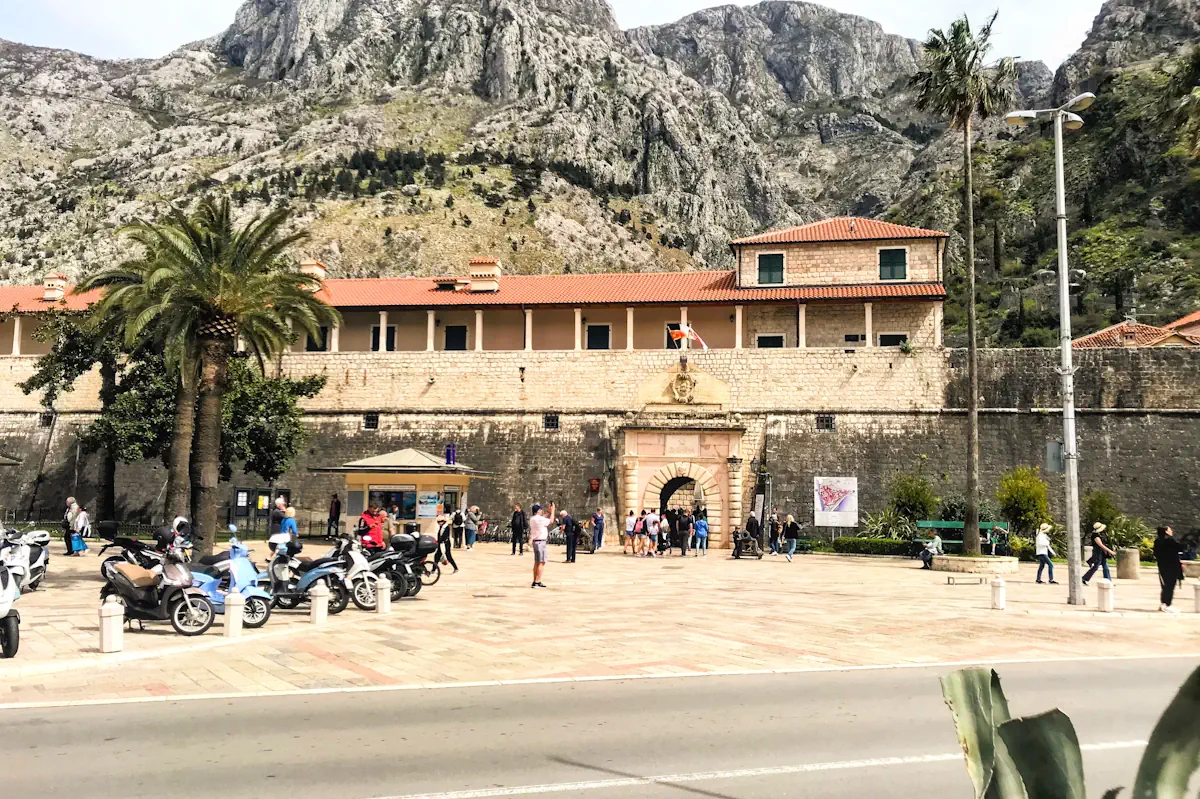
The Sea Gate and the Square of Arms serve as the primary entrance and the civic heart of Kotor’s UNESCO-protected Old Town. Built in 1555 during the Venetian era, the Sea Gate opens directly into the city’s largest longitudinal square, home to the 17th century Clock Tower, the Rector’s Palace, and the historic Pillar of Shame.
Sea Gate Built
1555 (Venetian)
Key Landmark
1602 Clock Tower
UNESCO ID
#1533
Square Type
Main Civic Center
A Chronicle of Venetian Defense
As the primary maritime entrance to the fortified city, the Sea Gate was designed to impress. While its heavy Renaissance style columns speak to the architectural stability of the 16th century, the facade itself serves as a stone canvas of Kotor’s shifting political identity. For centuries, the winged Lion of Venice stood here as the primary symbol of the republic’s maritime and political power.
The events of the mid-20th century transformed this landmark into a monument of resistance. Following the city’s liberation from Nazi occupation on November 21st, 1944, the Venetian carvings were replaced with socialist heraldry. Directly beneath the Yugoslav emblem’s six torches, an influential quote by Josip Broz Tito is inscribed: “What belongs to others, we don’t want, what is ours, we will never surrender.“
Historical Context: Josip Broz Tito
Tito was a communist revolutionary and leader of the Partisans, an anti-Axis resistance movement during WW II. He successfully managed to free Yugoslavia from Italian and German occupation, serving as the country’s leader for several decades.
The 15th Century Relief
Inside the vaulted passage, a beautifully carved 15th century stone relief has survived the centuries. It depicts the Blessed Virgin Mary with Jesus, flanked by Saint Tryphon and Saint Bernard.
The Heart of the Old Town
Upon passing through the Sea Gate, you emerge into the Square of Arms (Trg od Oružja), Kotor’s largest and most important civic space. Historically, this longitudinal square served as the central gathering point where soldiers would resupply and repair their weaponry during the Venetian era. Today, it remains the social hub of the city, located just a short walk from the cruise port and serving as the primary meeting point for almost all guided walking tours.
The square is anchored by the 1602 Clock Tower, a Renaissance and Baroque landmark that has survived numerous earthquakes. Throughout the year, the area transforms from a sun-drenched cafe terrace into the center of local culture, hosting the annual Christmas Market and the vibrant Carnival celebrations in February and August.
Square Highlights
- The Clock Tower: Built in 1602, featuring two functional clock faces that chime every hour.
- Rector’s Palace: The former seat of the Venetian governors, now housing part of the Boutique Hotel Cattaro.
- Napoleon’s Theatre: An 18th-century building converted into one of the region’s first theaters in 1810.
- Kampana Tower: Located in the northwest corner, this majestic bastion is one of the most iconic parts of the city walls.
Justice Under the Clock Tower
Standing directly in front of the 1602 Clock Tower is a small, pyramid shaped stone obelisk known as the Pillar of Shame. In the Middle Ages, this was the site of public punishment. Offenders were tied or chained to the pillar, forcing them to face the public gaze as a form of social humiliation. The intent was not only to punish the individual but to serve as a visual deterrent to the rest of the community.
A Note on the Clock Tower
The Clock Tower itself features two functional faces that still chime every hour. It has been a witness to centuries of history, surviving major earthquakes in 1667 and 1979, and remains the most recognizable landmark for anyone entering the Square of Arms for the first time.
Palaces and Hidden Alleys
Branching off from the Square of Arms, narrow stone corridors lead past the Bizanti and Beskuća Palaces. These lived-in streets connect the main piazza to Flour Square and the two primary arteries of the Old Town. One path leads toward the Kotor Cathedral, while the other heads north toward the historic churches of Saint Nicholas and Saint Luke.
For those looking for the best views in Montenegro, the trailhead to the Kotor Fortress (San Giovanni) is less than a five minute walk from the square. Along the way, the streets are lined with independently owned eateries and boutiques, maintaining the authentic atmosphere of a city that remains active and vibrant year round.
Kotor’s Cultural Map
- Maritime Museum: The essential stop for naval history, featuring a vast collection of Adriatic maritime artifacts, models, and nautical instruments.
- Church of St. Michael: Home to the Lapidarium, where you can view a collection of ancient stone columns, pedestals, and plinths.
- Cat Museum Kotor: A quirky and eccentric collection of cat themed artifacts, mostly in print, celebrating the city’s unofficial mascots.
- Pima and Buca Palazzi: Located just a few minutes walk into the interior, these are some of the best preserved examples of Gothic and Baroque architecture in town.
Expand Your Horizon
Beyond the Old Town Walls
Kotor is the perfect base for exploring the rest of Boka Bay.
Perast & The Islands
A short boat ride or 15-minute drive to the most romantic village in the Adriatic and its floating church.
Explore Perast →The Serpentine Road
25 hair-pin turns leading to Mount Lovćen for the absolute best view of Montenegro.
Drive the Serpentine →Dobrota Promenade
The “Local’s Kotor” – perfect for sunset walks, swimming, and seaside dining.
Walk the Coast →