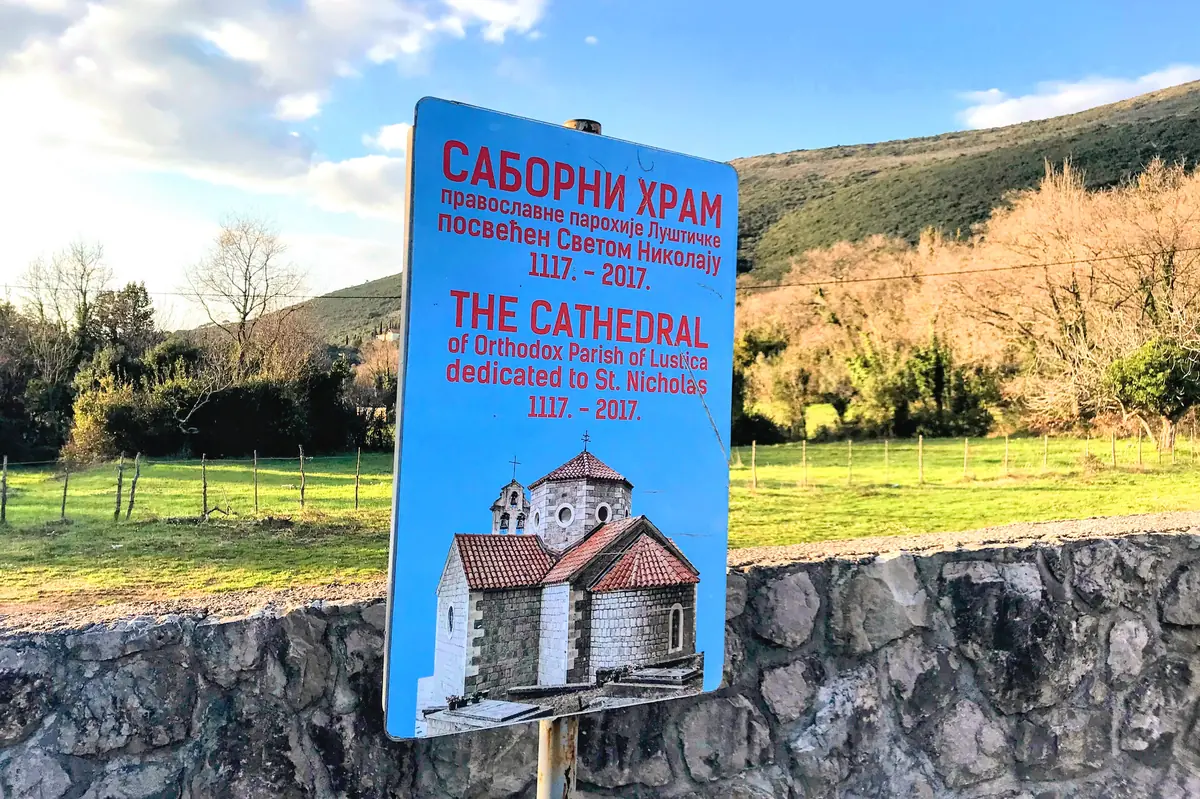
To understand the language of Montenegro is to understand the history of the Balkans itself – a tapestry of empires, mountain isolation, and Adriatic trade.
While you can easily navigate the stone streets of Kotor or the marinas of Budva using only English, the local tongue remains the heartbeat of the country. Whether it is written in the sharp lines of the Latin alphabet or the soulful curves of the Cyrillic, Montenegrin is a phonetic language where every letter has a purpose. Here is how to navigate the linguistic landscape like a local.
The Basics: The official language is Montenegrin, a melodic South Slavic tongue that shares deep roots with Serbian, Croatian, and Bosnian. While the history is complex, the reality for travelers is simple: you will hear a language that is phonetic, expressive, and – on the coast – heavily peppered with English and Italian influence.
The Essential Nine
Dobar dan
Good day
Hvala
Thank You
Molim
Please
Izvolite
Here you go
Da / Ne
Yes / No
Račun, molim
The bill, please
Koliko košta?
How much?
Oprosti
Excuse me
Ćao
Hi / Bye
The English Safety Net
If the grammar feels daunting, take comfort in the fact that
English is widely spoken along the coast. In restaurants, hotels, and boutiques, you will find high proficiency. However, once you head into the mountains of
Durmitor or the rural villages of
Prokletije, communication becomes a game of gestures and smiles. Learning a simple
“Dobar dan” (Good day) goes a long way in these regions – it is the universal key to Montenegrin hospitality.
Mastering the Sounds
Montenegrin is entirely phonetic: it is written exactly as it is spoken. Once you learn these five characters, you can read any sign in the country.
Š — sh as in “Shoe”
Č — ch as in “Chocolate”
Ž — zh as in “Casual”
Ć — cc as in “Cappuccino”
J — y as in “Yellow”
C — ts as in “Cats”
“Language in the Balkans is a mirror of identity. While linguists may see one language, the heart sees heritage.”
Language & Identity
In Montenegro, the question “What language do you speak?” often receives a nuanced answer. While Montenegrin is the sole official language, the population is linguistically diverse. According to the most recent data, roughly 42% of the population identifies their native tongue as Serbian, while 37% identifies as Montenegrin.
For the traveler, this distinction is largely invisible. Whether someone identifies their speech as Montenegrin, Serbian, or Bosnian, they are speaking the
Shtokavian dialect. You will find the strongest identification with the Montenegrin language in the old royal capital of
Cetinje and along parts of the coast, where the language is seen as a vital pillar of national independence.
A Unified Tongue
In 2017, prominent figures across the Balkans signed a declaration confirming that Montenegrin, Croatian, Serbian, and Bosnian are essentially the same language. For you, this means that the few phrases you learn here will grant you “linguistic keys” to almost the entire Western Balkan region.
The Dual Alphabets
Montenegrin linguists have established a perfect one-to-one correspondence between the two scripts. For every Latin letter, there is exactly one Cyrillic counterpart.
| Latin |
Cyrillic |
| A B C Č Ć |
А Б Ц Ч Ћ |
| D Dž Đ E F |
Д Џ Ђ Е Ф |
| G H I J K |
Г Х И Ј К |
| L Lj M N Nj |
Л Љ М Н Њ |
| O P R S Š Ś |
О П Р С Ш С́ |
| T U V Z Ž Ź |
Т У В З Ж З́ |
Note: Ś and Ź (С́ and З́) are the two unique letters introduced to reflect specific Montenegrin pronunciation.
Deepen Your Local Knowledge