
Kotor Old Town: The Ultimate Walking Guide & Best Sights

A visit to Kotor’s charming Old Town is always deeply recommended. Known in Montenegrin simply as ‘Stari Grad Kotor’, it is where most of the tourist attractions are located, such as the 12th-century Kotor Cathedral, the Kampana Tower, and of course the Kotor City Walls.

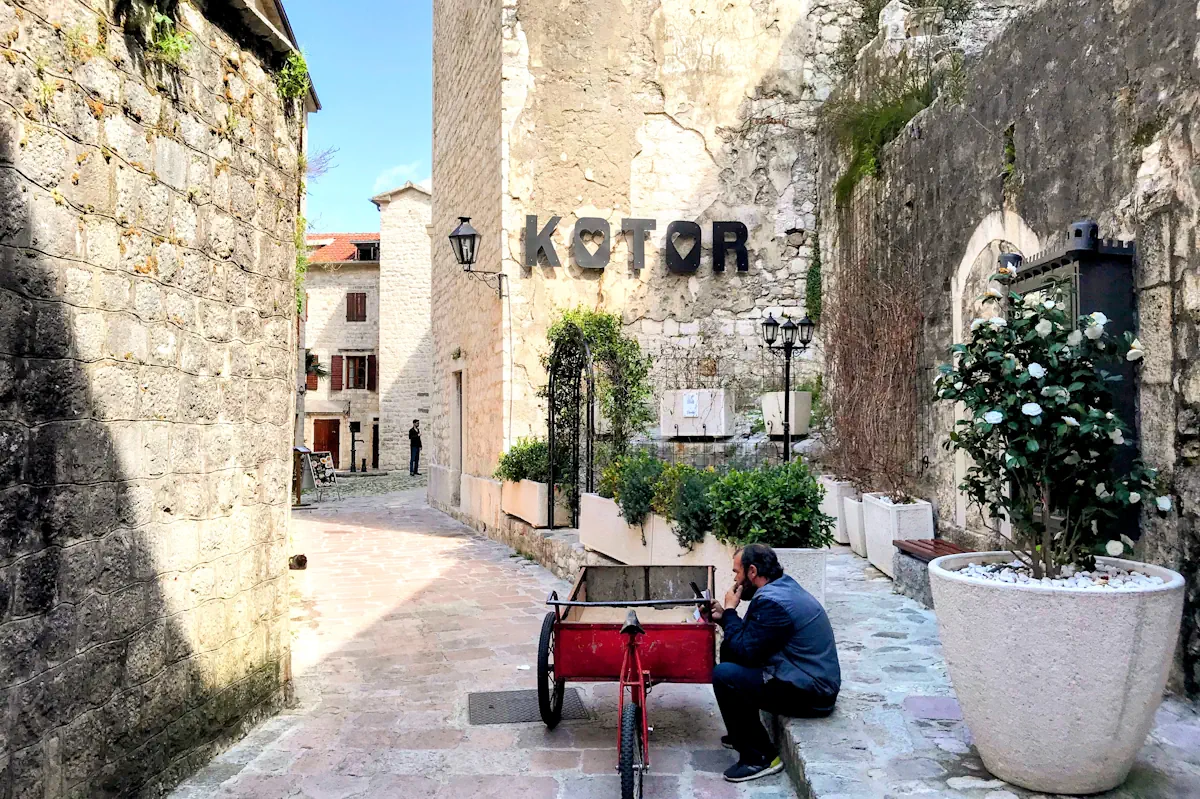
If you have some time on your hands, it’s a real delight meandering the ancient maze of medieval streets and discovering what is behind each corner. One thing is for sure, Romanesque and Byzantine churches, picturesque piazzas, and century-old courtyards are abundant in Kotor.

Feline enthusiasts will enjoy bumping into one of the innumerable cats that call the historical center home. Set your pace to a leisurely Mediterranean saunter and stop for a traditional puffy ‘Krempita‘ pastry in one of the many old town cafes, or an Adriatic feast somewhere special.

Kotor Old Town History

Illyrians, Romans, and Venetians have all left their mark on Kotor’s history. After the fall of Western Rome, Europe became a much more dangerous part of the world, and plunder and pillaging were very common. Facing periodic overruns by the Barbarians of the East, the strength of Kotor’s defensive walls was frequently put to the test.

The Serbian Prince, Stefan Nemanjic, conquered Kotor in the 12th century, and it is this period that has left us with some of the city’s most iconic edifices with Romanesque, Byzantine, and Gothic influences like the Kotor Cathedral and the Church of Saint Luke

The Fortifications of Kotor, which are the city’s major landmarks, have been largely reinforced during the period of Venetian Rule (1420 – 1797) on remnants of earlier Byzantine and Illyrian structures. The Winged Lion of Venice that you can see on the city walls to both sides of the Sea Gate, is a stark reminder of their time in the Bay of Kotor. 

Stately homes (locally also known as palazzi) dating back to the 17th and 18th centuries are a meaningful feature of the historic part of town. Sensitively restored, some of them have become luxury boutique hotels, their marble and wrought iron balconies giving away their ancient history.

Parking close to Kotor Old Town

Bear in mind that finding available parking close to Kotor Old Town can be challenging at times, especially during the peak season in July and August. Due to its mountainous landscape, parking space is in short supply in Kotor. There are five main parking lots managed by the city council.

The Walking Tour

Rich in history, culture, and gastronomy, there is more than enough to do and see in Kotor. A city tour is a good way of getting yourself familiar with the main sights, and you will benefit from detailed insights from an experienced guide who will answer any of your questions.

Alternatively, navigate through the narrow maze of cobblestone streets on your own and discover new and exciting restaurants, intimate shops, and quaint courtyards. Soak up the atmosphere at the Square of Arms and admire the refined and intricate architecture of the clock tower from 1602 and the “pillar of shame” in front of it.

Kotor’s historic center is well-preserved and the massive Venetian-era Kotor City Walls have been listed as one of Montenegro’s UNESCO World Heritage Sites since 1979. A network of bastions, gates, and ascending ramparts (illuminated at night) cast a defensive circle around the medieval town. 

Kotor Old Town is located on a triangular piece of land confined by the River Scurda to its north and the mountain of St. John (San Giovanni) towards the East. The southwestern side is the longest and opens up to the Bay of Kotor. You can enter the walled city through three gates:

  • Northern Gate 
  • Gurdic Gate
  • Sea Gate

The Northern Gate is also called the River Gate because access is granted from the small bridge over the Scurda River. From here, you can look up onto the medieval ramparts and even see the Kotor Fortress, the Bembo Bastion, and the Kampana Tower.

The Renaissance-influenced gate dates back to the 15th century and is a little less impressive than the main Sea Gate. Once inside, you will find the beautiful Saint Mary’s Collegiate Church to your right-hand side and the trailhead to Kotor Fortress to your left.

The Gurdic Gate also known as the ‘Southern Gate‘ dates back to the 10th century and is the only one featuring a wooden drawbridge. The surrounding area is very photogenic. You can even climb up there for a beautiful view of the Gurdic Bastion and the neighboring city walls. 

Almost all visits to Kotor start at the eye-catching Sea Gate, built in 1555. While passing through it, imagine that this was once only accessible by sea, the plateau where you are walking was added centuries later. Notice the relief of Madonna with Child and Saint Tryphon, the city’s patron saint, set in a niche in the vaulted passage.

The Sea Gate

Charming Kotor has, since the 9th century, been defended by city walls of one form or another. Kotor Fortress (also known as San Giovanni orSt. John’s Fortress) dates back even further – to Illyrian, pre-Roman times. To this day, substantial portions of Kotor’s City Walls remain, making Kotor have more intact walls than any other coastal town in Montenegro.

The walls areup to 20 meters high and go right up to the top of Kotor Fortress on Mount San Giovanni. They are the longest city walls in Montenegro, measuring 4,5 kilometers and including numerous bastions and city gates. These walls are extremely thick in some places, as becomes evident as soon as you enter through the Sea Gate, where they measure 16 meters.

The city walls are punctuated by two additional gates, the North Gate and the Gurdic Gate. These sole entrances into town protected from potential invaders and pirates, and were also used to collect tolls from merchants. The Sea Gate (also known as the ‘Main Gate‘) is the tallest and most elaborate of the three, and was built in 1555 during the period of Venetian rule over Kotor (1420 – 1797), and was previously only accessible by sea.

The gate’s most notable features were the winged Lion of Venice, which adorned the plaque above the entrance, and two griffins holding the coat of arms. The Venetian-era carved insignias were replaced during the Second World War by socialist-style Yugoslav heraldry, texts, and symbols.

On the frieze, where once the Lion of Venice stood, you’ll see now a memorial tablet showing Kotor’s liberation date from Nazi occupation – November 21st, 1944. Where once you could admire two gryphons proudly holding up the city’s coat of arms, there’s now the Emblem of Yugoslavia, boasting six torches with a red star at its top.

A quote by Yugoslav strongman and partisan leader Josip Broz Tito was added beneath it. It reads “What belongs to others, we don’t want, what is ours, we will never surrender.” Tito was a communist revolutionary and leader of the Partisans, an anti-Axis resistance movement during WW II, and managed to free Yugoslavia from Italian and German occupation.

The gate is supported by Renaissance-style columns, and there are two metal cannons guarding the main entrance to the old town. On the inner side of the vaulted passage, you will find a beautiful 15th-century stone relief, depicting the Blessed Virgin Mary with Jesus, surrounded by Saint Tryphon and Saint Bernard.

The gate opens onto the Square of Arms, Kotor’s main town square that houses important historical landmarks such as the clock tower from 1602. From the Sea Gate, the city walls resume north and south around the Kampana Tower and the Gurdic Bastion, anchored by Mount Lovcen to one side and the Scurda River to the north.

If you are visiting Kotor’s Old Town for the first time, this is probably the gate through which you will enter. The Sea Gate is within footwalk distance of the cruise port and almost all city tours start in front of it. Riva Square also plays host to the annual Kotor Christmas Market and the New Year celebrations.

Kampana Tower

Kotor’s city walls are a series of 4,5-kilometer-long defensive stone walls that stretch completely around the old town, from the Sea Gate via the Kampana Tower and the Gurdic Gate up to Kotor Fortress, which sits at an altitude of 280 meters, guarding the entrance to the harbor and Kotor’s Old Town.

The walls reach a maximum height of about 20 meters and a width of up to 16 meters on the side facing the sea. They include six bastions of which the bell-shaped Kampana Tower is the most prominent. Its round, bulky shape constituted the ideal silhouette for deflecting cannon balls and keeping invaders at bay.

The Kampana Tower anchors the river-facing north wall to the western city wall and is one of the first things visitors to Kotor see when arriving by sea. It was first erected between the 13th and 14th centuries but was completely rebuilt in the mid-16th century when Kotor belonged to a province that was part of the Republic of Venice (1420 – 1797).

The city walls, encompassing the Kampana Tower, the Bembo Bastion, the Gurdic Bastion, and the three city gates, are still largely intact and are among the most well-preserved Renaissance-era fortifications on the shores of the Adriatic Sea. Together with other Venetian Works of Defense across the Mediterranean, they are listed as a UNESCO World Heritage Site and are a major tourist attraction.

And while the Kampana Tower was notoriously hard to access by sea, getting to the top via its interior staircase is easy nowadays. Enjoy breathtaking views of the emerald-green Scurda River, the scenic Square of Arms with its distinctive 17th-century clock tower, the Kotor Cruise Port, and large swaths of the Bay of Kotor from above.

The moat surrounding the Kampana Tower is filled with water from the Scurda River. It is easy to see how it had served as a natural line of defense back in the day. By the early 16th century, the expanding Ottoman Empire became an imminent threat to Kotor. It was the Siege of Castelnuovo (Herceg Novi) in 1539 under Hayreddin Barbarossa, that ultimately made the Venetians strengthen their fortifications around the old town.

It did not take long until major progress was made: the Bembo Bastion and the North Gate were finished only one year after the siege, in 1540, and the Sea Gate was finalized in 1555. Luckily, the Kampana Tower required only a small upgrade because most of its construction was done in prior centuries.

The Ottoman Empire never conquered Kotor, perhaps thanks to the Kampana Tower which still stands today, but the only things it defends Kotor from these days are the hordes of cruise ship tourists who come to visit this charming gem of a town that remains almost perfectly preserved in its Renaissance and Baroque form.

There’s a small park with a fountain adjacent to the bastion where you can sit on one of the benches and reflect on its rich history, or simply relax and marvel at its beauty. The Kampana Tower is beautifully lit up at night, making it a picturesque walk-by site, too. The Benovo Parking Lot is right adjacent to it, making it easily accessible if you have your own vehicle.

The Square of Arms

The Square of Arms is a large, longitudinal square entered through the Sea Gate, and featuring some of Kotor’s most important landmarks such as Rector’s Palace, Napoleon’s Theatre, and the clock tower from 1602. In front of the tower stands a tiny stone obelisk (“pillar of shame”) which was a place of punishment in the Middle Ages.

Hundreds of years ago, offenders of certain kinds were tied or chained to it and then publicly humiliated. It rarely took long for the whole town to find out about the poor man’s or woman’s transgression, and the feeling of embarrassment and humiliation would stick perpetually. When the poor soul was finally released, the sight of the looming pyramid-shaped pillar would suffice to strike fear deep into the mischief-maker’s heart.

The Arms Square houses a couple of interesting landmarks such as the 17th-century clock tower, Napoleon’s Theatre, and Rector’s Palace (both part of the Hotel Cattaro today). In the Middle Ages, soldiers would gather here and resupply and repair their weapons – thus the name. The tower features two clocks that are still in function and chime once every hour.

Which museums and galleries you’ll consider worthwhile will depend on your personal preferences. For people interested in Kotor’s naval history, head to the Maritime Museum; to view ancient columns, pillars, pedestals, and plinths, and pop into the Church of St. Michael’s Lapidarium. At the quirky and excentric Cat Museum Kotor, you’ll find a diverse collection of cat artifacts, mostly in print.

Even though this medieval practice has been discontinued, there is still a solemn atmosphere about this chipped and weathered relic of the past. The pillar blends in well with the clock tower; you almost need to look twice to differentiate it against the backdrop of wrinkled stone blocks.

On the northern end of the square stands the ochre-colored Napoleon’s Theatre. This 18th-century edifice was turned into one of the region’s first theaters by the French occupation forces in 1810 when Napoleon Bonaparte ruled over large parts of Europe and beyond. Since 2006, this iconic building has made up part of the 4-star Boutique Hotel Cattaro.

The Rector’s Palace stretches over almost the square’s entire western flank, incorporating the sea gate into its structure. It was built during the Venetian period and used to accommodate local district governors – il provveditori. Besides these most prominent buildings, there is a smattering of beautiful, well-preserved palazzi that are home to a wide range of shops and services.

Part of Kotor’s charm lies in the lived-in streets that are bustling with locals who come here for work or leisure – and not only tourists. The Bizanti and Beskuca Palaces sit on a narrow street that connects the Square of Arms with the Flour Square which is home to a series of other important landmarks of Kotor such as the Pima and Buca Palazzi.

Several events are celebrated here with lots of singing and dancing. It’s the endpoint for the passionate and fiery Carnival celebrations in February and August. The Square of Arms is anchored in the northwest by the majestic Kampana Tower and in the south by the waterfront (“Riva”) where you can find oceanfront restaurants as well as numerousboat tour operators and water taxis.

The Square of Arms connects with the two main old town arteries, which lead to Kotor Cathedral on one side, and the Milk Square with the churches of Saint Nicholas, Saint Luke, and Saint Mary on the northern side of the old town. Less than five minutes away is the trailhead to Kotor Fortress, and many intimate bars, shops, and cafes along the way.

The Square of Arms is an inevitable stop during your tour of the walled city and is the heart of Old Town’s 100+ independently owned eateries and boutiques. Some of Kotor’s best old-town restaurants and best old-town hotels are situated within footwalk distance of the square.

St. Tryphon’s Cathedral

In the heart of Kotor’s Old Town stands the magnificent 12th-century Kotor Cathedral and, as one of the main landmarks in Montenegro’s most charming coastal town, it’s a must-visit. Nearly impossible to miss, this imposing white twin tower edifice is one of Southeastern Europe’s oldest and tallest Romanesque churches and certainly a magnificent sight for those arriving by sea.

Its most prominent feature is perhaps its two Baroque bell towers which increased the Cathedral’s height to 35 meters when they were added to the structure during reconstruction works in the aftermath of the devastating earthquake of 1667. You might need to look twice to discover that they are not symmetrical. The northern tower is two meters shorter than its southern neighbor because the upper part has never been completed, presumably due to a lack of funds.

Over the years, the St. Tryphon Cathedral changed its appearance many times to incorporate then-contemporary architectural styles, and that is why besides Romanesque elements, you’ll also find Gothic, Renaissance, and Baroque details and components in the church’s exterior and interior. 

The story of St. Tryphon’s Cathedral began in 809 AD when Kotor was still part of the Byzantine Empire, ruled from Constantinople, today’s Istanbul. In that year, Andreaccio Saracenis, one of Kotor’s distinguished residents, went on a mission to the then-capital of the Eastern Roman Empire to acquire Saint Tryphon’s relics and bring them back to his hometown.

Adreaccio was successful in his endeavor and returned to Kotor with the relics of the saint. Shortly after, he started building a modest chapel dedicated to him, Saint Tryphon, the new patron saint of Kotor. Three centuries later, in 1166, a much larger cathedral would be erected on the same grounds where the small chapel once stood.

Compared to other buildings in its immediate surroundings, the new St. Tryphon’s Cathedral would stand as highly visible evidence of Andreaccio’s successful mission, to find a safe sanctuary for the saint’s remnants, safely conserved in a handcrafted silver chest, and has remained there until today.

The annual St. Tryphon’s festivities, which extend over a two-week period in January and February, are closely intertwined with the traditions of the Boka Navy, a maritime organization dating back to the start of the 9th century. In the course of the celebrations, serving navy members traditionally kick off the festivities with their performance of the UNESCO-listed kolo circle dance on Cathedral Square on January 27th.

On the eve of St. Tryphon’s Day (February 3rd), officers of the Boka Navy, dressed in beautiful traditional uniforms, are selected for a special assignment. They have to carry the skull and bones, which are revered as relics of Saint Tryphon, in a series of solemn processions through the cobblestone streets of Kotor’s Old Town to the Square of Arms and back to the Cathedral. Thousands of visitors jam the narrow streets as the town celebrates its rich and storied past.

Inside the church, the naves are laid out by a series of brick and Corinthian pillars with capitals, while the floor decorations boast an inlaid marble mosaic. Throughout the centuries, the Saint Tryphon Cathedral underwent several changes at the hands of many renowned local and international artists. Unfortunately, only a few vibrant 14th-century frescoes that used to adorn almost the entire church’s interior, have been preserved.

One of the most dramatic additions was the new ciborium, dating back to the second half of the 14th century. It was most likely contributed by one of Vitus of Kotor’s pupils. This beautiful work of art, which is decorated with pre-Romanesque interlace compositions, contemplated another, smaller ciborium from the 9th century.

An 18th-century addition was the four marble altars crafted by Venetian artists. The relief depicting the Blessed Virgin Mary with Christ among saints is an excellent example of Montenegrin Baroque art. Another highlight is the silver altarpiece which was contributed in the mid-15th century by various artists from Kotor, Venice, and Switzerland.

It depicts twenty biblical characters, including John the Baptist, John the Evangelist, Paul the Apostle, and Bartholomew the Apostle, and is widely considered to be one of Kotor’s most notable pieces of sacral artwork. The two figures of Saint Peter and Christ were forged by John of Basel in 1440 while the sculptured reliefs of Saint Jerome and St. Francis were added by the Venetian master goldsmith Venturin in the 17th century.

The altarpiece which is placed behind ared-marbled ciborium also features an image of Saint Tryphon, dating back to 1378, as the central figure beside Christ. He holds a miniature of Kotor, complete with the city walls and Kotor Fortress, in his right hand, and a palm frond in his left hand, symbolizing martyrdom. The intricate architrave depicts various scenes from his life. Back in the day, the ciborium would include curtains that would be drawn closed during important church rituals and liturgical services.

The Cathedral’s Relic Chapel is a Baroque work by Italian sculptor Francesco Penso Cabianca. It is a circular red room with a star ceiling and includes some of Penso’s most beautiful sculptures and reliefs. Relics of special note that are preserved here are the Glorious Head of Saint Tryphon, safeguarded in an exquisite reliquary, using some of the finest materials available and crafted by various artists between the 13th – 17th centuries.

There is also the Reliquary Casket of Saint Tryphon which dates from the mid-16th century and conserves several bones of the patron saint. The reliquary is decorated with silver relief plates depicting scenes of the life of St. Tryphon. One relief shows how he is violently quartered by horses while another one portrays him being whipped. A third relief paints a picture of Saint Tryphon being tortured by fire and stoned to death.

The assembly of the silver casket coincides with a very tumultuous period in Kotor’s history: the advances of the Ottoman Navy into the Bay of Kotor that culminated in the Siege of Castelnuovo and the Battle of Perast. In the aftermath of these events that took place in 1539, large swaths of coastal Montenegro were occupied by the Ottomans, including Herceg Novi and Risan.

Kotor was able to stop the invaders at its city gates and remained under Venice’s control until the Republic’s collapse in 1797. The reliquary figures torturing Saint Tryphon are depicted as bearded and turbaned Ottomans, with sabers hanging from their belts. One relief shows a soldier in Turkish military dress decapitating Saint Tryphon and presenting the severed head to Aquilinius.

In addition to the Glorious Head and the Reliquary Casket of Saint Tryphon, the chapel treasures an amazing collection of other relics, well-preserved in limb-shaped silver, wood, or glass containers. One reliquary contains stones that were presumably thrown at Jesus while another one guards parts of a wooden cross which is claimed to be the one on which Jesus was crucified.

Besides many unique artifacts, vestments, metal works, and paintings, there is also the original marble sarcophagus in which Saint Tryphon’s relics were transported to Kotor in the 9th century. The chapel is enclosed with a large red wrought iron gate which is adorned with a silver antependium from the 17th century by Venetian artist Venturin. There is a small entrance charge.

The St. Tryphon’s Cathedral is one of the oldest landmarks in Kotor. It was erected in 1166 to honor Kotor’s patron saint – Tryphon. You should take some time to admire the beautiful 14th-century frescoes and the stone ornament above the main altar, depicting the life of Saint Tryphon.

The churches of Saint Luke (XII century), Saint Nicholas, and Saint Mary (XIII century) are worth a visit if you are into iconography, centuries-old frescoes, and relics of long-gone times. All churches stand in close vicinity to each other and can be visited in one go.

Kotor: The City of Cats & The Cat Museum

For Kotor, cats have unmistakably been a part of daily life and popular culture for centuries. Walk through the streets of the old town and see people feeding and petting an armada of stray cats. Some recycling machines dispense dry cat food in exchange for plastic bottles – throw two bottles in and receive a handful of granules in return.

Among Kotor’s purrmanent residents, there are hundreds or thousands of cats occupying the town’s narrow streets and charming squares. Presumably, the first ones arrived in the Middle Ages by merchant ships from faraway lands to help fight the plague in 1346. Cats were immediately welcomed because they would hunt rats, snakes, and other animal carriers of rampant diseases.

Nurtured by Kotor’s tight-knit community, their lives were quickly woven into the old town’s fabric. Today, cats are the symbol of Kotor, and you will find their motifs printed on every other souvenir. And while Kotor’s coat of arms depicts a red lion, it is probably only a matter of time before it gets replaced by its cuter, smaller feline relative.

The Cat Museum of Kotor is the love child of curator Pierro Pazzi, a collector from Venice, Italy, who amassed this impressive collection of cat memorabilia and art over many decades, which is now on display in the heart of Kotor’s Old Town. And between hundreds of cat-inspired postcards, antique advertising, coins, and posters, there are some funny and genuinely unorthodox finds such as a stamp from 1927 showing a cat motif for the furrr-st time ever.

The museum opened its doors in 2013 and boasts a rich collection of thousands of items that span from the 16th century to the present day. Most of the pieces stem from a private collection donated by an Italian countess while others came to the museum via targeted purchases and further donations from all over the world.

The Cat Museum is home to one cute resident cat that roams the two museum rooms meowing, welcoming affection, and patiently allowing to be petted by visitors. Feline enthusiasts and those with a fondness for those quirky pussy muses of past centuries will undoubtedly feel at home here.

The collection of international prints and drawings is informed by a deep sympathy for the lives of cats and provides a guide to some remarkable stories of the amazing art history of our feline friends. So we can learn that cat motifs started to appear first in Minoan, Greek, and Roman art, disappeared almost entirely during the Middle Ages, and emerged again during the Renaissance.

The oldest exhibits in the Cat Museum date from this monumentally transformative period. By the 19th century, cats appeared as subjects in artwork everywhere, and some authentically interesting examples are presented on the walls and shelves of the Kotor Cat Museum, including what seem to be the first cat-themed postcards.

The museum’s mission is to bring cat art and cat education to the Montenegrin public through seasonal exhibitions that run from May to October every year. There are also some controversial pieces like the one picture showing Russian President and strongman Vladimir Putin petting his cat.

The Cat Museum of Kotor is located on the cinema square, adjacent to the Church of Saint Michael. If you are looking for an authentic and beautiful souvenir from Kotor, you might strike it rich in the museum’s store filled with funny cat merchandise. Here, you can choose from diverse prints, souvenir magnets, and of course the Cats of Kotor City Calendar (5€).

The Cat Museum Kotor
Facebook | Website
Location: Trg Gospa od Anđela – Stari Grad 371, 85330 Kotor
Opening Hours: 10 am – 8 pm (May to October)

Entrance Fee: 1€ (adults) and 0,50€ (children)

The small entrance fee goes towards feeding and providing medical care to Kotor’s feral cats.

The Fešta Spirit

The streets of Kotor’s Old Town come alive during its numerous festivals and celebrations. The Venetian-style Carnival (Summer and Winter) and the Boka Night (August) are outstanding events in Kotor that offer a captivating experience of the Boka region’s vibrant culture.

During the carnival celebrations, the streets are colorful and everyone wears beautiful masks and costumes, creating a contagiously cheerful and silly atmosphere. Winter is of course the time for the amazing Kotor Christmas Market and the Winter Fest with numerous concerts over two months.

Eat & Drink

From Turkish Cuisine to authentic Montenegrin restaurants serving hearty lunches and light Adriatic fare, there is something for every palette and budget within the walled city. It’s the perfect place to immerse yourself in the food and drink culture of Montenegro and beyond.

Places to Stay

Kotor’s Old Town is well-known for its intimate boutique hotels housed in historic townhouses with antique stone walls and exposed ceiling beams, the best of them offering stunning rooftop views. Staying so close to the city’s rich history is the most enriching experience.

How long to spend in Kotor Old Town?

It is pleasant to spend some time strolling around Kotor’s narrow cobblestone streets and admiring its beautiful historic buildings. Some people can do this for longer than others. Be aware however that the old town of Kotor is small; it counts no more than 1,000 inhabitants.

If you just want to rush through all the main sites, you can certainly do it within a few hours. Adding a few activities to your itinerary like climbing up the city walls, taking a boat trip to Our Lady of the Rocks Island, and checking out the local Bar scene, will require spending at least three or four days.

Kotor’s old town is incredibly lively during the tourist season from June to September and becomes much quieter in the other months of the year. If you are visiting in winter, a day trip might be enough though – some shops are closing for the colder months.

Living in the Old Town

Kotor’s medieval Old Town is a desirable place to live, with numerous old townhouses now converted into luxury apartments. Rooftops with terraces and sea views are available as well but at a premium. Gregarious and culture-rich, there’s always something going on in the historical center.

While some resorts in Montenegro shut down after the summer season, the majority of restaurants and shops stay open even during winter. The Dobrota coastal promenade provides a picturesque route for cyclists and walkers, and the crystal-clear Adriatic Sea is always at your command.

Kotor’s great quality of life and exclusive lifestyle opportunities have been internationally recognized; in 2023 it was voted Winner of the World’s Top 5 Jetset Retirement Destinations in Forbes Magazine.

Andreas
Andreas

I am a resident (and citizen) of the Montenegrin coast, dedicated to uncovering the authentic side of the Adriatic beyond the typical tourist brochures. Whether I’m exploring the Grbalj hinterlands for the best local produce or navigating the ancient alleys of Kotor’s Old Town, my guides are built on first-hand experience and a love for Montenegro’s complex history.

Articles: 219